

Mental Health Is Real
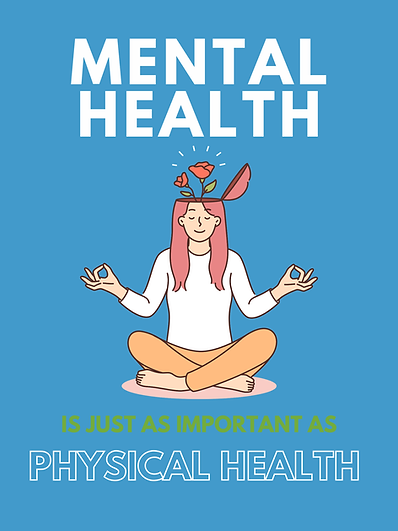
Check on yourself and loved ones!
We live in a world where people are expected to keep going no matter what they feel inside.
Smile anyway. Work anyway. Show up anyway. Post anyway. Perform anyway.
But the truth is — mental health is real.
Not every battle leaves visible scars. Some people are fighting anxiety while answering emails. Some are struggling with depression while still taking care of everyone around them. Some are overwhelmed, burned out, emotionally exhausted, or silently questioning their worth while appearing completely “fine” on the outside.
Mental health does not always look dramatic. Sometimes it looks like losing motivation. Cancelling plans. Overthinking everything. Feeling disconnected. Being irritated easily. Struggling to sleep. Feeling emotionally numb. Crying in silence. Or simply feeling tired of carrying so much for so long.
The World Health Organization reported that around 1 in 6 people worldwide experience loneliness, especially young adults and teenagers. https://www.who.int/teams/social-determinants-of-health/demographic-change-and-healthy-ageing/social-isolation-and-loneliness
According to the Centers for Disease Control and Prevention, recent U.S. data showed that 1 in 5 adults have been diagnosed with depression or anxiety disorders.
https://www.cdc.gov/mental-health/about-data/conditions-care.html
The American Psychological Association released a report called Stress in America 2025: A Crisis of Connection, highlighting how loneliness, misinformation, and social division are increasing emotional stress and negatively affecting health.
https://www.apa.org/pubs/reports/stress-in-america/2025
World Health Organization also reported that over 1 billion people globally are living with mental health conditions, showing how widespread emotional and mental struggles have become.
A recent survey found that 54% of young adults and 69% of college students experienced mental or behavioral health concerns in the past year.
Reports continue showing that burnout is becoming a major issue worldwide, with stress from work, finances, social pressure, and constant connectivity impacting people daily. And yet, so many people minimize what they feel because they think someone else “has it worse.”
But pain is pain.
Stress is stress.
Emotional exhaustion is real.
Taking care of your mental health is not weakness. It is not attention-seeking. It is not laziness. It is necessary.
In a culture that glorifies overworking, constantly being available, and always being productive, people often forget that rest, peace, boundaries, and emotional healing matter too. You cannot continuously pour into others while ignoring yourself.
Healing may look different for everyone. For some, it may be therapy. For others, prayer, journaling, conversations, exercise, meditation, creative expression, taking breaks, saying no, or simply allowing themselves to slow down for once.
At The House of Wellness Med Spa, we believe wellness is more than beauty treatments or appointments. It is creating space for people to breathe, reset, recharge, and reconnect with themselves again. Sometimes self-care looks like taking one hour away from the noise to simply rest your mind and body.
Whether it’s a massage to release tension, a facial that helps you slow down, quiet time alone, or simply allowing yourself to be cared for for once — those moments matter more than people realize.
Self-care is not selfish.
Rest is not laziness.
And taking care of your mental health should never make you feel guilty.
Be kind to people.
You never fully know what someone is mentally carrying.
Mental health is real.
And you deserve spaces, people, and experiences that support your healing journey.


The subject of exploring the paths taken by graduates feels more interesting when there is room for a reader to stop and ask their own questions. A career story can show the changes and decisions that a short job title leaves out. That connection helps me see why graduate career pathways can be worth a closer look. I am more curious about the process than a polished result, because the steps in between are usually where questions appear. Which questions would make an interview with a graduate useful for current students?
I find making maths understandable through clear examples easier to think about when there is a concrete question to start from. Following one worked example slowly can reveal the reasoning behind a method. This is why I would approach mathematics learning support with a specific question rather than a fixed expectation. I am still thinking through the details, and a small example would help me picture how this works in practice. What helps a learner move from copying a solution to choosing a method independently?
Thinking about keeping educational competitions enjoyable, I find the smaller practical questions more interesting than a quick conclusion. A challenge can be motivating when the experience matters alongside the final result. I would use that point as a starting question when considering student learning competitions. I would probably come back to this question after trying to work through one concrete example rather than deciding immediately. How can a competition reward curiosity and persistence as well as correct answers?
There is something approachable about discussing choosing books for a varied reading collection through situations people can actually picture. A balanced collection can include familiar interests and a few titles that invite something new. It also gives the phrase book selection ideas a clearer meaning than a label on its own. The part I would like to explore further is what happens when the idea meets a real situation with its own limitations. How do you choose books for readers with very different tastes?
What draws my attention to building everyday cybersecurity awareness is the possibility of making an unfamiliar subject feel closer to everyday life. Recognising an unexpected message is a useful first step before deciding whether to trust it. I would use that point as a starting question when considering cybersecurity awareness basics. I would probably come back to this question after trying to work through one concrete example rather than deciding immediately. Which examples make online safety lessons memorable for beginners?